Your AIpportunity Starts Here: From Fresher to Shaper in 2026
A practical career roadmap for every stage of India's tech workforce — from freshers to veterans — navigating the AI revolution in 2026 and beyond.
AICAREER
Mukesh Shende
4/3/202611 min read
Imagine you have exactly 90 seconds in an elevator with a hiring manager at a top Global Capability Center (GCC) in Hyderabad or Bangalore. Do you spend that time explaining what you coded — or why it matters to their business?
In an era where according to Indeed's 2024 hiring study 42% of Indian hiring managers report difficulty finding candidates with the right mix of digital and soft skills, your answer to that question defines your AIpportunity.
I didn't start with a Computer Science degree or a silver-spoon campus placement. Twenty-five years ago, before graduation I worked as a clinic compounder, after graduating in Commerce selling mobile SIM cards to support my family. I entered IT during the era of Windows 3.1 and floppy disks — not through a prestigious college/university gate, but through curiosity, grit, and relentless upskilling. Since then, I've navigated every major technological shift — from 3SharePoint to Cloud Architecture, from Agile to Generative AI — rising to Director of Technology Solutions.
If one truth has remained constant across a quarter-century of disruption, it is this: AI is not a threat to your job. It is an opportunity to amplify your impact. Whether you are a fresh graduate preparing for your first interview or a 25-year veteran navigating a volatile market, the path forward is the same — bridge the gaps between technical execution and business value. This roadmap is built for every stage of that journey.
The Starters — Freshers Looking for Internships
The Challenge
India produces 1.5 million engineering graduates annually, yet roughly 45% are considered immediately employable by industry surveys. The gap isn't your GPA or your GitHub commits — it's your inability to connect technical work to business outcomes. Many remain tongue-tied in interviews, unable to tell their own story with clarity and confidence.
The Strategy
Transition from Campus Instinct to Impact Mindset. Your degree gets you the invitation — your impact gets you the job. In 2026, raw coding ability is a baseline. Your differentiator is articulation, ownership, and production-awareness from day one.
Action
Master the STAR Method for every interview answer — structure your stories as Situation, Task, Action, Result. Practice the 90-Second Challenge: explain your final year project to a non-technical person without using a single line of jargon. If you can't, you're not ready yet.
The Goal
Achieve a successful internship-to-full-time conversion — which ranges from 50–70% for interns who demonstrate proactive ownership of end-to-end features, not just assigned tickets.
Takeaways
🎯 Practice: The 90-Second Challenge — pitch your project like a product, not a submission
📋 Framework: STAR Method for all behavioral interview answers
🏅 Certification: AWS Certified Cloud Practitioner or Microsoft Azure Fundamentals or Google's Associate Cloud Engineer — serve as powerful credibility signals in a crowded market
💡 Mindset: Treat communication skills as a core technical skill, not a soft extra
The Builders — Talent with 1 to 5 Years of Experience
The Challenge
You know the syntax. You may not know the systems. Graduates at this stage can code an algorithm but struggle to work within a live codebase, follow branching strategies, or understand why a deployment pipeline matters. Various industry reports suggest that only 15-20% of IT projects succeed — most fail because engineers never learned to think in production terms.
The Strategy
Solve the Production Gap. The shift isn't about learning more languages — it's about understanding how code lives in enterprise environments. Every company runs a production system that doesn't care about your localhost.
Action
Stop zipping files and start building CI/CD pipelines using GitHub Actions or Jenkins. Internalize the 12-Factor App principles. Use Git as a collaboration tool, not a backup drive — meaningful commit messages and clean branching strategies separate junior engineers from mid-level thinkers.
The Goal
Secure the 20–30% salary premium that certified Cloud and DevOps professionals command in the Indian market in 2026. Move from being a coder to being a system design thinker who understands architectural trade-offs between monoliths and microservices.
Takeaways
📋 Framework: 12-Factor App (Created by Heroku co-founder Adam Wiggins) checklist for cloud-native readiness
🏅 Certification: AWS Solutions Architect, Associate or Azure Administrator (AZ-104), Google Professional Cloud DevOps Engineer
🛠️ Practice: Deep Git fluency — PRs, code reviews, conflict resolution
📚 Guide: System Design fundamentals — focus on trade-offs in storage, compute, and networking
The Value Creators — Talent with 5 to 10 Years of Experience
The Challenge
Stagnation at this stage often comes from a dangerous assumption: that business context is someone else's job. Senior engineers who can only speak in technical metrics — latency, memory, CPU — become invisible to decision-makers. According to a 2025 study in the Inverge Journal of Social Sciences organizations that align AI initiatives across business functions see 75% higher ROI improvements than those working in silos.
The Strategy
Connect Code to Money. Move from being a coder to a solution provider who understands unit economics. Every architectural decision you make has a cost per transaction, a revenue implication, or a churn consequence. Learning to speak that language is what earns you a seat at the table.
Action
Use any of the following business-aligned frameworks to sharpen your thinking — pick the one that fits your context best and practise it consistently:
Amazon Working Backwards (PR/FAQ) — Before writing a single line of architecture, write a mock Press Release and FAQ for your feature. If you can't clearly state the customer benefit in plain language, you don't have a product — you have a cost centre.
OKR Framework (Objectives & Key Results) — Define what success looks like in measurable terms before building. A feature that reduces cart abandonment by 15% is an OKR-aligned goal; "improve checkout flow" is not.
RICE Scoring (Reach, Impact, Confidence, Effort) — A prioritisation model developed by Intercom that forces engineers to quantify the value of their work before committing resources. In 2026, product-minded engineers who can RICE-score their backlog are significantly more promotable.
Value Stream Mapping (VSM) — A Lean methodology that helps you visualise the entire delivery pipeline — from code commit to customer value — and identify waste. If your feature takes 3 weeks to reach production but only 2 days to build, VSM shows you where the real problem lives.
North Star Metric — Identify the single metric that best captures the value your product delivers to customers, then align every engineering decision to it. For a SaaS product, it might be Daily Active Users. For an e-commerce platform, it might be Repeat Purchase Rate.
The Goal
Advance into tech lead or architect roles by demonstrating how your optimisations — such as a 30% reduction in checkout latency — drive measurable conversion lift or cost savings. Frame your impact in business language, not just technical specs.
Takeaways
💰 Practice: Unit Economics — map your technical work to revenue gained or cost reduced
📋 Frameworks: Amazon Working Backwards, OKR, RICE Scoring, VSM, North Star Metric — pick one and go deep
🏅 Certification: Professional certifications signals your ability to lead cross-functional agile teams
📚 Model: Jobs to Be Done (JTBD) — focus on why users hire your product, not just what it does
The Architects — Talent with 10 to 15 Years of Experience
The Challenge
At this stage, the stakes are no longer personal — they're organisational. According to EMA Research's 2024 analysis unplanned downtime now costs large enterprises an average of ₹11–20 lakh per minute (approximately $14,000). One misconfigured deployment, one missed alert, one under-designed failover — and the losses are catastrophic. The gap isn't technical skill; it's the discipline of Operational Excellence.
The Strategy
Champion Resilience by Design. Shift from being reactive to bugs to being proactive about system health. The most valuable engineers at this level are those who prevent the crisis, not just the ones who heroically resolve it at 2 AM.
Action
Implement SRE Golden Signals defined by Google's SRE team — monitor Latency, Traffic, Errors, and Saturation as the minimum standard for production health. Embed Security-by-Design into every architectural decision: input validation, authentication layers, and robust logging are not afterthoughts.
The Goal
Deliver measurable cost savings through downtime prevention — the kind that translates to a ₹20–25 crore impact on enterprise P&Ls. Position yourself as the leader who connects technology strategy to financial outcomes, moving from the architect's chair toward the boardroom.
Takeaways
📋 Framework: SRE Incident Lifecycle — Detect → Triage → Mitigate → Learn (blameless post-mortems)
💰 Strategy: Cloud FinOps — establish financial accountability across cloud environments for 20–24% cost optimisation
🏅 Certification: PMP (Project Management Professional) or ACP Agile Certified Practitioner with a 20–33% salary uplift in India
📚 Practice: Security-by-Design — incorporate threat modelling from sprint zero, not post-production
The Navigators — Talent with 15 to 20 Years of Experience
The Challenge
The uncertainty at this stage is real — geo-political volatility, AI-driven workforce restructuring, and the constant pressure of staying technically relevant while leading large teams. Many professionals in this zone chase titles when they should be building impact. Professional designations are important, but sustainable career security comes from delivering value through effective teams, not from org chart positions.
The Strategy
Value Impact Over Titles. Focus on becoming a Rare Deep Leader — one who is equally fluent in technology strategy, business outcomes, and people leadership. This intersection is where 2026's most sought-after profiles live.
Action
Develop strong Financial Awareness — learn to read a P&L, understand cloud cost allocation, and present technology investment decisions in language that resonates with CFOs and CEOs. Stakeholder fluency at this level is non-negotiable.
The Goal
Position yourself as a strategic leader who can drive large-scale digital transformations in regulated sectors — Banking, Healthcare, Defence — where your 15+ years of domain depth is a genuine competitive moat that no fresher or AI tool can easily replicate.
Takeaways
📋 Framework: Governance Maturity Models — align technology risk with enterprise strategy using IT governance assessments
🏅 Certification: Executive Programmes or Advanced Business Strategy credentials — bridges the rare gap between technologist and business strategist
💡 Resilience: Nurture creative outlets and strong professional relationships to sustain leadership under prolonged uncertainty
💰 Side Strategy: Leverage deep domain expertise to explore advisory or consulting roles alongside primary employment
The Practitioners — Talent with 20 to 25 Years of Experience
The Challenge
Here is the honest truth most people won't say out loud: at this stage, the fear isn't about AI replacing you — it's about being seen as too expensive, too specialised, or too set in your ways. Many professionals in this bracket feel the quiet pressure of being passed over for roles that go to someone younger and cheaper, or finding that their deep expertise is valued in theory but bypassed in practice. The challenge is equal parts professional and personal.
The Strategy
Stay a practitioner, not just a title-holder. The most credible senior leaders in 2026 are those who can still sit in a design review and contribute meaningfully — not just approve slides. Your value is not in managing people away from problems; it is in having the judgment to solve the right problems in the first place.
Action
Start building parallel credibility channels — beyond your day job. That could mean writing about what you know (a LinkedIn post series, a workshop, a talk at a local tech community event), taking on a fractional advisory role for a mid-sized startup, or formally mentoring two or three professionals from earlier career groups. These aren't side hustles — they are proof-of-relevance in a world that rewards visible expertise.
The Goal
Reframe your career from a single ladder to a portfolio of contributions — your corporate role, your community presence, your mentorship impact, and your domain authority all working together. This is what genuine resilience looks like at this stage: not one job, but many reasons you matter.
Takeaways
🤝 Practice: Start mentoring intentionally — two or three mentees from earlier career groups keeps your instincts sharp and your network alive
📋 Framework: Personal Brand as Strategy — your LinkedIn, your speaking, your writing are professional assets, not vanity metrics
🏅 Certification: ITIL Practitioner or a focused upskill in a modern domain (Cloud FinOps, AI Governance, MLOps) — not to compete with juniors, but to speak their language credibly
💡 Ethos: Mean it. Manifest it. Make it happen — not as a motivational poster, but as a daily operating discipline
The Shapers — Talent with 25+ Years: Reshaping the Future
I'll be honest — I almost didn't write this section. Because for those of us in this phase, being advised by someone our own age or younger can feel tone-deaf. So let me not do that. Instead, let me share what I am thinking about, wrestling with, and working toward — as someone who is very much still in the middle of this chapter, not looking back at it.
Where I Find Myself
The question I wake up with is no longer "how do I stay relevant?" It has quietly shifted to something more uncomfortable and more exciting: "What am I actually building — and for whom?" A quarter century of navigating technological shifts, leading transformations, and anchoring enterprise-level pursuits has given me something I couldn't have bought with any certification. I can see where organisations are heading before they can. That is both a gift and a responsibility.
What I Am Thinking About
I am no longer just delivering IT services. I want to be part of reshaping what IT means — moving it from a cost centre conversation to a strategic partnership conversation. In my own work, that means pushing past the comfort of familiar frameworks and asking harder questions: Are we building AI systems that organisations can actually sustain, govern, and grow? Or are we just shipping impressive demos that stall in production?
I think about the GitHub's research found developers using Copilot complete tasks up to 55% faster - and I wonder whether most organisations are structured to actually capture that gain, or whether it just disappears into more meetings and bigger backlogs. That gap between potential and reality is where I believe people like us need to plant our flag.
What I Am Doing About It
I am investing in having more honest conversations with CXOs about the difference between AI experimentation and AI implementation. And I am mentoring — not because it looks good on a profile, but because the Class of 2026 deserves better guides than an algorithm. Going by several industry reports India will need nearly 2+ million cloud and AI professionals by 2027. I think, those of us in this room — the ones who have seen every wave come and go — have a genuine obligation to help build that pipeline with wisdom, not just velocity.
What I Believe
Tech stacks will keep expiring. The half-life of any specific skill keeps shrinking. But the ability to translate complexity into clarity, to connect technology to human outcomes, and to build teams that outlast any single project — that never expires. That is the work I want to be known for in this chapter.
Takeaways (these are mine — take what resonates)
🤖 Bet on: Agentic AI and Computer Vision solving real industrial problems — Pharma, Retail, Manufacturing — not just enterprise chatbots
🏛️ Build: MLOps governance maturity — model lifecycle management, drift detection, and production readiness are where most AI projects quietly die
👥 Shift: From degree-centric to impact-centric — the most important hiring decision in 2026 is whether someone can think, not just code
💡 Remember: The Right Work — use AI to eliminate the routine so that human intelligence can focus on the irreplaceable
The Road Ahead...
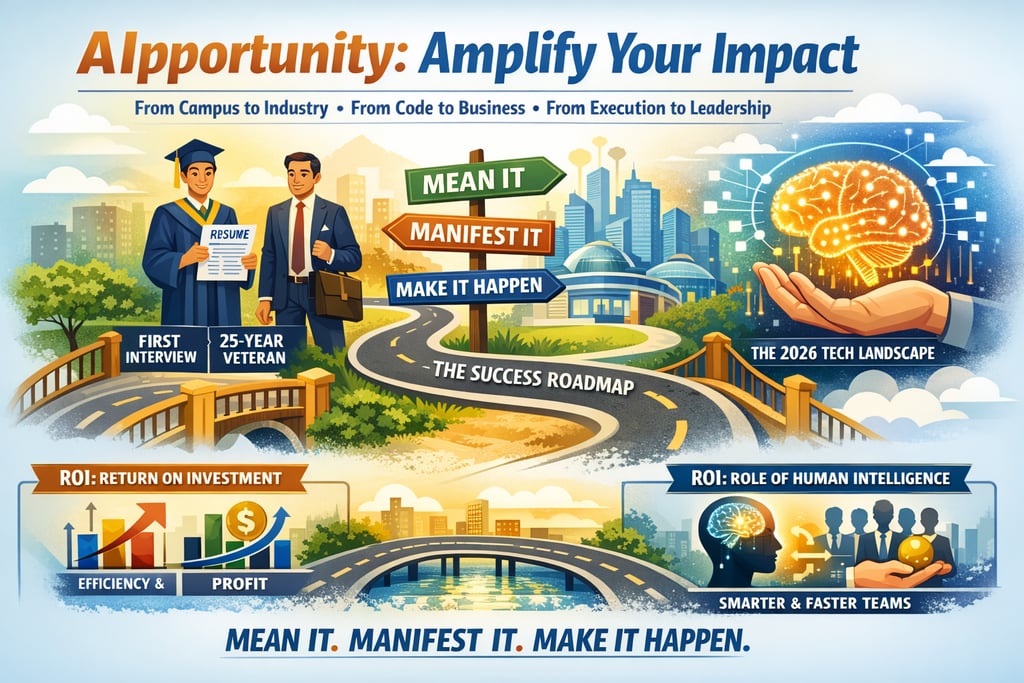
Twenty-five years ago, I walked into IT not through the front door, but through a side entrance — armed with a B.Com degree, a floppy disk, and an unshakeable belief that consistent effort aligned with clear goals could move mountains. From selling SIM cards on the streets of Mumbai to leading AI-driven transformations for global enterprises, I've lived proof that technology changes, but the law of attraction — paired with relentless execution — does not. The 2026 tech landscape belongs to those who bridge the gaps: between campus and industry, between code and business, between execution and leadership.
But here is what AIpportunity is really about. Every major technology revolution in history — mainframes, the internet, mobile, cloud — created more opportunity than it destroyed. AI is no different. The disruption is real, the anxiety is valid, and the pace of change is genuinely unlike anything we have seen before. What is missing is not information — it is practical guidance that goes beyond theory.
AIpportunity is built to do exactly that. Our mission is to go beyond frameworks and thought pieces, and build real-world playbooks — for professionals, teams, and organisations — that make AI implementation practical, measurable, and human-centred. Because when done right, AI doesn't just deliver ROI as Return on Investment. It amplifies ROI as the Role of Human Intelligence — making every person in your organisation smarter, faster, and more impactful. That double ROI is the AIpportunity.
Whether you are zipping your first codebase, creating first AI Agent or building the next Center of Excellence, the roadmap is the same. Mean it. Manifest it. Make it happen.
This article is the first in the AIpportunity Series — a deep-dive into each career group, with practical playbooks, real case studies, and 2026-aligned tools. A note on process: I used AI as a thinking partner in drafting and refining parts of this post — the same way a writer uses an editor. Every word has been reviewed, every statistic verified, and every opinion is mine. That's a standard I'll hold across every edition. Follow along at aipportunity.in and never miss a post.
Have a question about your specific career stage? Drop it in the comments below — your question might become the next post.
© 2026 AIpportunity.in | Turning Technological Uncertainty into Opportunity & Competitive Advantage
explore@aipportunity.in
Connect
Mean it. Manifest it.
Make it happen.
Mission
© 2026 AIpportunity.in
Contact
Hyderabad, India